I’m 175 years late to the party, but here’s my take on Moby Dick
Moby Dick by Herman Melville was this month’s read for my book club. For those of you unfamiliar with the story, it’s about Captain Ahab and his monomaniacal pursuit of the titular white whale, as told by Ishmael, one of the sailors on board the whaling vessel, the Pequod. It also starts with one of the most famous opening lines in literature: “Call me Ishmael.”
Perhaps fittingly, a story about whale hunting is a whopper. We had previously set a limit of 300 pages for our book choices, to help us get through each book in a single month. So I’m not sure what we were thinking when we agreed upon Moby Dick, which was by far the longest book to date at 625 pages (excluding explanatory notes). Together with the archaic language, it meant it was quite a slog to get it read in time. But I’m glad I finished it, and it left me reflecting on my own family history and the opportunities I’ve had to travel the world in the modern day.
Fiction as a non-fiction guide
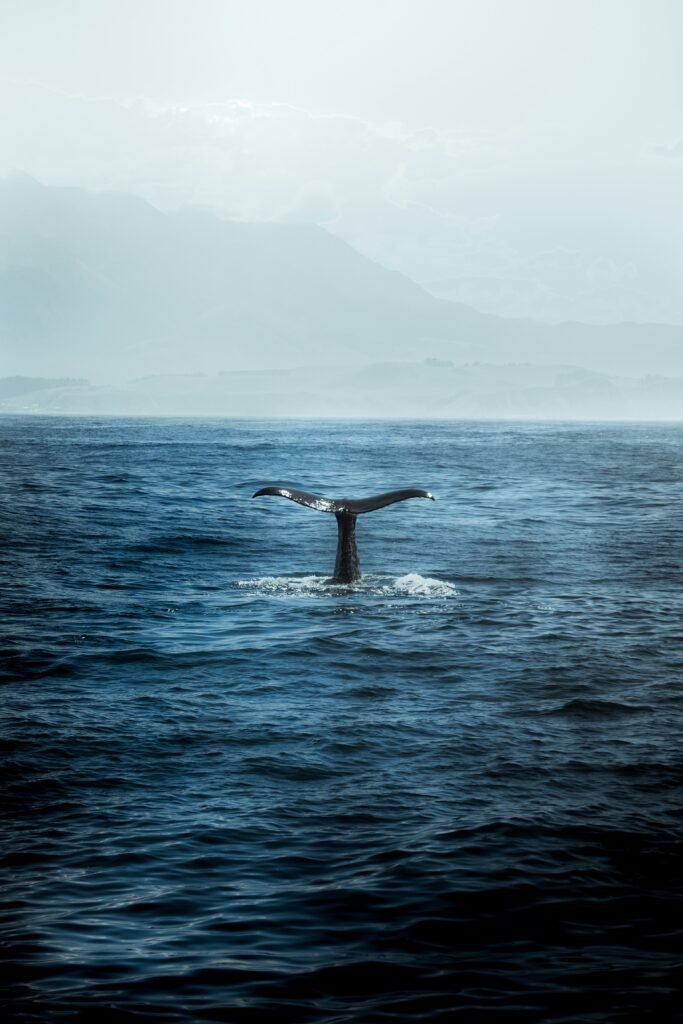
What struck me about reading Moby Dick was how much of it was dedicated to essays on the whaling industry. I was expecting a book that focussed on the fictional story, rather than the many non-fiction tangents about whales and the wider whaling industry. For example, there were chapters on the Pequod‘s Blubber Room (use your imagination for this grim one), how to cut up a whale, differences between the head of a sperm whale and right whale, a classification of whales that has not aged well (Melville insists that, in is view, whales are not mammals but fish), as well as chapters dedicated to the significance of the colour white, and the various uses of sperm whale oil (and other body parts) across society at that time.
The tangents were all quite interesting, but they must have taken up at least 50% of the word count, if not more, which really slowed the pace down despite the chapters often short length (some chapters were a single page). It left me with the feeling that the book was part story and part love letter to / defence of the whaling industry.
And that got me thinking. Given that Moby Dick was published in 1851, at a time before the internet (obvs) and when access to reference materials was much more limited, a book like Moby Dick was also a way to show the public the wider world beyond their doorstep and an insight into an important industry. Nowadays, I might simply Google a reference in a book that interests me (a city, or person, or one of the many Biblical or Classical references in Moby Dick), whereas Melville went to great lengths to describe this to his readers and to show them the fascinating (and grim and brutal) whaling world. He had no choice but to do so.
Now, don’t get me wrong, all literature transports the reader to some extent. What was a surprise was how much of the book was given over to these tangents. Tangents that, I suspect, would now be removed by editors if it was published today. And it made me realise I take for granted how much I, as a modern writer, can now get away with in trusting that my readers will be able to picture, for example, what a sperm whale is and looks like without having to dedicate whole chapters to describing their anatomies.
Wait, what? How is my family connected to a 19th Century whaling story?
It isn’t, well, not directly. However, one of my ancestors was a whaler.
My great-great-grandfather, John Sjöberg, was born in Stockholm, Sweden, in 1856. At some point in his life he joined a whaling ship. What he’d think of me, a vegetarian opposed to the whaling industry, I can only imagine. But I digress. So the family story goes, when John’s ship was anchored off the coast of Australia, John and his friend swam ashore and each married one of the two daughters of the farmer whose land they first set foot on. John married Elizabeth Carboon (originally ‘Carlborn’) whose father was Swedish and whose mother was from Cornwall, England. I wouldn’t want to guess why Elizabeth’s mother was in Australia…cough convict? cough, nor can I comment as to whether shotguns were involved with their rather prompt weddings or the veracity of this story, but it makes for a fun tale.
Along came my great-grandfather, Ernest (1887), who married Annie Saturley (1891), an Australian woman. For reasons I do not know, they moved from Australia to Swansea, Wales, where my grandfather (William Dudley, known as Dudley), was born in 1914. Some of my grandfather’s nine siblings remained in Australia, those that were born Down Under, and there’s still a branch of the family out there today. Some seven decades years later, I was born in Swansea, and over a hundred years after my Grampa Scoberg’s birth, so too were my three children.
With all this context, reading Moby Dick was a ‘Who Do You Think You Are?’ kind of moment for me. It struck me that I was getting an insight into the whaling industry and the world in which my ancestor, John Sjöberg, lived. That certainly helped me as I read through the numerous whaling essays Melville liberally scattered throughout the book. It gave me a personal connection to a book written some 175 years ago about an industry I strongly oppose.
As an aside, The surname Sjöberg (meaning ‘sea mountain’, according to Google) became ‘Scoberg’, I presume, because his name was recorded phonetically by an official during John’s time in Australia.
Ripples through time
I’ve always had a strong urge to see what was beyond the horizon. Me and my wife backpacked across Thailand, Australia, New Zealand, and Fiji in our twenties, I also taught English in China after after graduating university, trekked to Mt. Everest Base Camp in Nepal, and (with my wife) emigrated to New Zealand (before returning to Wales).
Reading Moby Dick also got me thinking about what kind of person John Sjöberg was. What sort of life did he live in Sweden and what led him to become a whaler? I wondered if he had the same wanderlust I have, and if that’s where I get it from, perhaps? Now, I don’t know why John jumped off that whaling ship, but having read the depictions of whales getting slaughtered, the incredibly long voyages (3 to 4 years each) and the general conditions on board, it’s certainly not what I would want to be doing with my life. But what if that was the only means he had to escape his life and see the world? Would I have done the same in his shoes? It made me feel grateful for the opportunities I’ve had in life, and how I’ve been lucky enough to travel the world, especially without having to kill any whales to do so!
This is one of the things I love about a good book, that they can make you stop and reflect, put yourself in someone else’s shoes, and to see a world so alien to your own. Regardless of how much I actually enjoyed Moby Dick, it was worth reading it for this personal reflection alone.